


Care Support
Find Care
Post a job or search by postcode to find a suitable carer.
SIGN UP NOW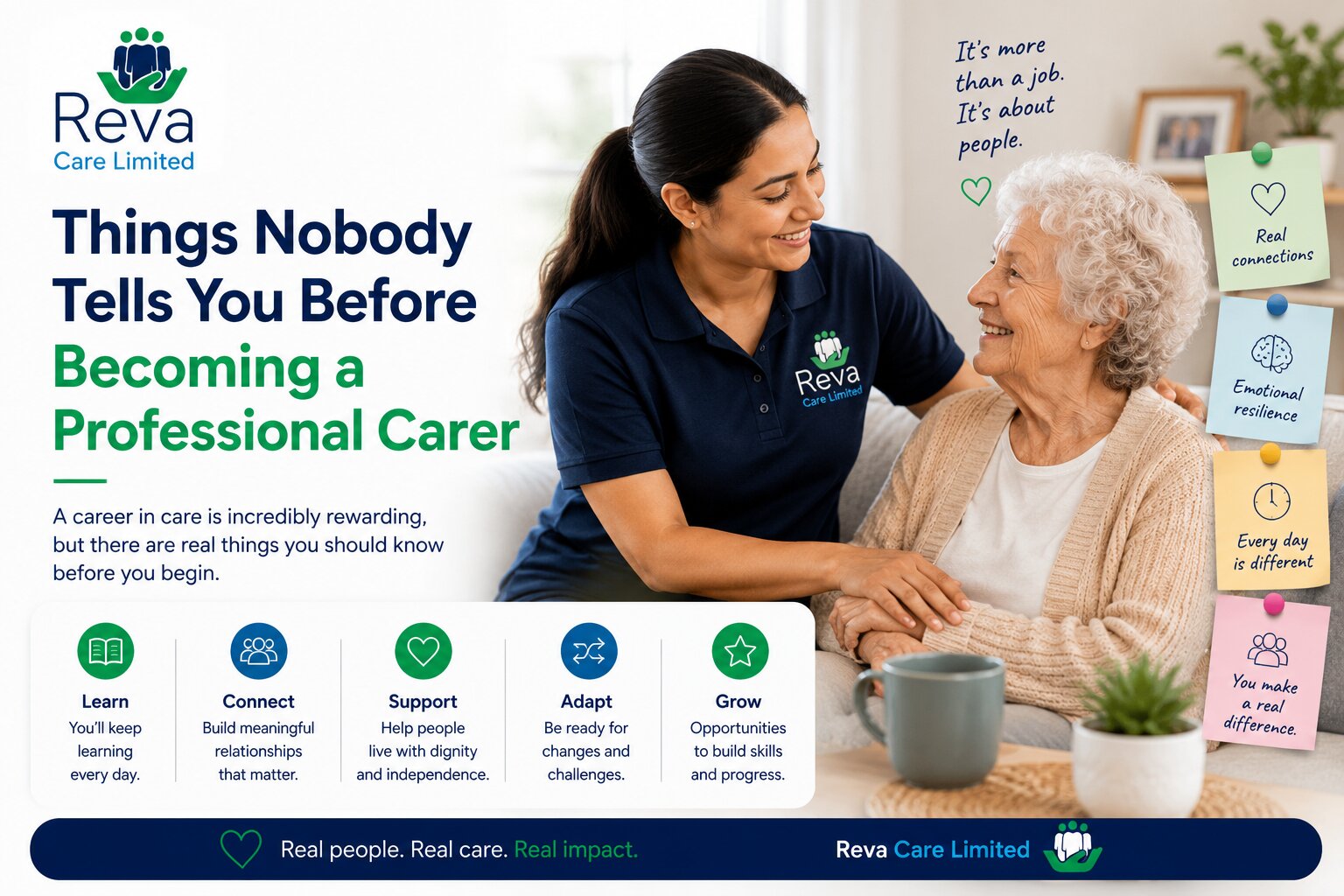
Becoming a professional carer can be one of the most meaningful career choices you make.
You get to support people through some of the most important moments of their lives, help them maintain their independence and sometimes simply be the person they can rely on.
But there are also parts of the job that you may not fully understand until you experience them.
It isn't just about helping someone with their daily routine.
It isn't just about completing a list of tasks.
And it certainly isn't something you can fully learn from a job description.
There is a human side to care that you only discover when you become part of it.
Here are some things worth knowing before you start.
One of the biggest misconceptions about starting a career in care is that you need to arrive with years of experience and every skill already mastered.
That's not necessarily the case.
Skills for Care says that you don't always need previous experience or qualifications to enter social care. What matters greatly is having the right values and attitude towards supporting people.
You will learn through:
Training
Induction
Experience
Working alongside colleagues
Feedback
Everyday interactions with the people you support
The important thing is being willing to learn.
You don't need to know everything. You need to be willing to keep learning.
There is no single definition of what "care" looks like.
One person might need help with personal care.
Another might need support getting to appointments.
Someone else might need encouragement to remain independent or simply benefit from companionship.
Care workers can support people with a wide range of needs, including older people, people with disabilities and people living with mental health conditions.
This means you can't approach every person in exactly the same way.
You have to learn:
What matters to them?
What makes them comfortable?
What do they want to do themselves?
What support do they actually need?
Good care starts with seeing the person, not just the task.
This is something that is difficult to understand before entering the profession.
You may build genuine connections with the people you support.
You may celebrate their progress.
You may laugh together.
And sometimes, you may also be there during difficult or emotional moments.
That can be incredibly rewarding, but it can also be challenging.
Professionalism doesn't mean becoming emotionally detached or uncaring.
It means learning how to remain supportive while maintaining appropriate professional boundaries.
Skills for Care's guidance on being a professional highlights the importance of managing your own emotions while remaining focused on providing effective care.
And importantly, looking after yourself isn't selfish.
Your own wellbeing matters too.
You might think caring is mainly about practical tasks.
In reality, communication is everywhere.
You may need to:
Listen carefully
Explain something clearly
Understand what someone is trying to communicate
Speak with family members
Work with other professionals
Record information accurately
Raise concerns when something doesn't seem right
Sometimes communication isn't even about talking.
A change in someone's behaviour, mood or routine can tell you something too.
That is why being observant and genuinely listening can be just as important as knowing what to say.
Skills for Care identifies communication, teamwork, problem solving and other core skills as important across social care roles.
Care is people-focused.
And people don't always follow a schedule.
A shift might start with one plan and change completely because someone's needs have changed.
You might have to prioritise something unexpected.
You may encounter challenging behaviour.
You may need to ask a colleague for support.
You may have to adapt quickly.
Being a good carer isn't about making sure nothing ever goes wrong.
It's about being able to stay calm, think clearly and respond appropriately when things change.
Flexibility and the ability to respond calmly to changing circumstances are among the behaviours Skills for Care highlights for people working in social care.
Another thing people don't always associate with care is paperwork and digital work.
Professional carers may need to complete records, update care information, communicate with colleagues and use digital systems.
Skills for Care identifies digital skills as one of the core skill areas for social care workers, including accessing digital information and updating records.
So while your role is centred around people, you also need to be comfortable with the systems that help keep their care safe and organised.
Good documentation is part of good care.
Starting the job is only the beginning.
Care is constantly developing, and there are opportunities to build specialist knowledge and progress into different roles.
Depending on your role, training can cover areas such as:
Moving and handling
Health and safety
First aid
Dementia care
Autism awareness
End-of-life care
Communication
Digital skills
Skills for Care describes the Care Certificate as a foundation for people new to health and social care, covering the knowledge, skills and behaviours expected in care roles.
There are also opportunities to progress through further qualifications, apprenticeships and more senior positions.
So becoming a carer doesn't have to mean staying in exactly the same role forever.
There can be a career path behind the first job.
Caring for other people can sometimes make it easy to forget about yourself.
But knowing when you need support is an important professional skill.
You might have a difficult shift.
You might feel overwhelmed.
You might need advice from a colleague or manager.
Asking for help doesn't mean you're not capable.
It means you understand your limits and want to make sure you can continue providing safe and effective care.
Skills for Care's values guidance specifically highlights recognising when you need help and support and when work is affecting your wellbeing.
You cannot pour from an empty cup.
This may be the biggest thing nobody tells you.
The most memorable part of your job may not always be the big achievement.
It could be:
A conversation over a cup of tea.
Helping someone feel confident enough to do something independently.
Remembering their favourite routine.
Making someone laugh.
Being there on a difficult day.
These moments might seem small from the outside.
For the person you're supporting, they may mean everything.
That's what makes professional care different from simply completing a list of responsibilities.
The social care sector continues to need skilled people.
Skills for Care reported that England's adult social care workforce grew in 2025/26, with around 22,000 more filled posts than the previous year. At the same time, the sector still had around 96,000 vacancies on any given day.
That means there is an ongoing need for people who want to build meaningful careers in care.
But the real opportunity isn't simply finding a job.
It's becoming someone another person can trust.
Someone who helps them stay independent.
Someone who protects their dignity.
Someone who makes their day a little easier.
Qualifications and training matter.
But they aren't the whole story.
Skills for Care highlights values such as dignity and respect, learning and reflection, working together, and commitment to quality care and support.
The qualities that can make a difference include:
Patience.
Because not every day will be easy.
Empathy.
Because you need to understand the person behind the need.
Communication.
Because good care depends on being able to listen and explain.
Resilience.
Because some situations will challenge you.
Curiosity.
Because every person can teach you something.
Humility.
Because you won't always have all the answers.
And perhaps most importantly:
Respect.
Because the person you're supporting isn't defined by their age, condition or care needs.
They are still themselves.
Nobody should enter professional care believing every day will be easy.
It won't.
There will be demanding shifts.
There will be difficult conversations.
There will be moments when you question whether you handled something in the best way.
But there will also be moments that remind you why you chose this career.
A person trusting you.
A family thanking you.
Someone becoming more independent.
A smile after a difficult day.
Those moments can stay with you.
Care is not an easy career.
It is a human one.
If you're already working in care, there's probably something you wish someone had told you before your first shift.
Maybe it was something practical.
Maybe it was about handling emotions.
Maybe it was something nobody could have explained until you experienced it yourself.
💬 What is ONE thing you wish someone had told you before becoming a professional carer?
Share your experience and help someone who is considering a career in care.
👉 Continue the conversation with us on LinkedIn:
[Insert LinkedIn Post URL]
Becoming a professional carer is about much more than learning how to perform a set of tasks.
It's about learning how to support people while respecting their choices, dignity and independence.
You'll develop practical skills.
You'll learn to communicate better.
You'll become more confident handling unexpected situations.
And, if you stay open to learning, you can continue developing throughout your career.
But perhaps the most important thing to know before starting is this:
You may begin the job thinking you're there to care for someone else.
You may discover that the people you support teach you just as much about patience, resilience, kindness and humanity.
That's the part of a career in care that no job description can fully explain.
Post a job or search by postcode to find a suitable carer.
SIGN UP NOWRegister your care home and connect directly with suitable carers.
REGISTER CARE HOMECreate your profile, complete verification and find local jobs.
SIGN UP NOW