


Health News
Find Care
Post a job or search by postcode to find a suitable carer.
SIGN UP NOW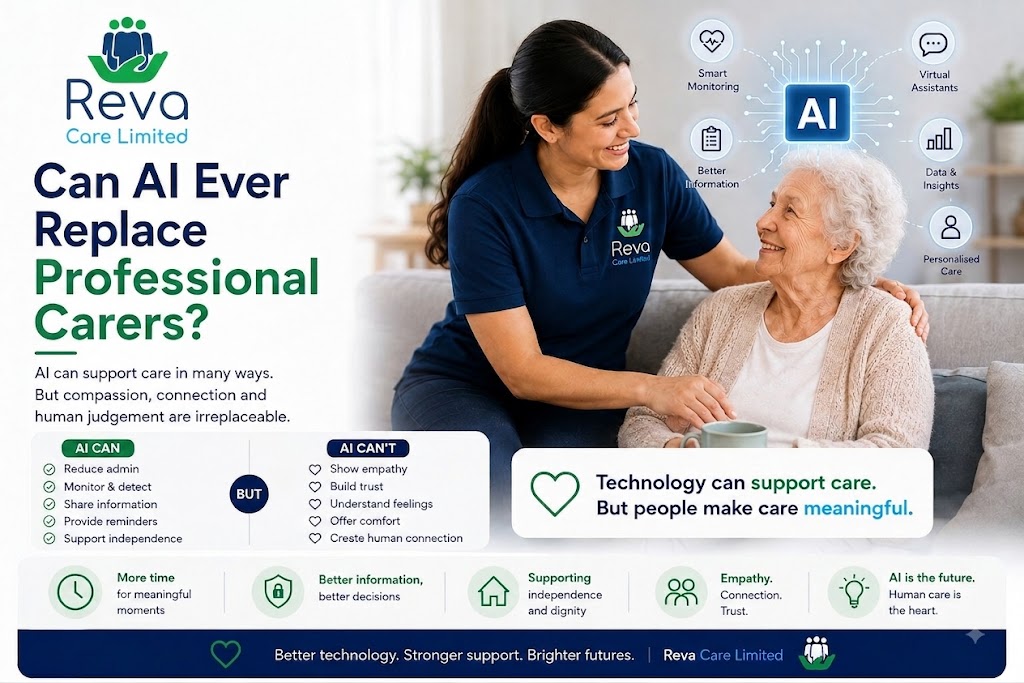
Artificial intelligence is changing almost every industry.
From helping businesses analyse information to supporting doctors with clinical tools, AI is becoming part of everyday working life.
Social care is no different.
AI and other technologies are already being explored for tasks such as monitoring, administrative support, communication and personalised care. Skills for Care says AI has the potential to improve the quality, efficiency and personalisation of adult social care.
But this raises an important question:
Can AI ever replace professional carers?
Our answer is simple:
AI can support care. But replacing the human relationship at the heart of care is a very different challenge.
AI is not just about humanoid robots.
It can take many different forms.
Technology can help with:
Administrative tasks
Documentation
Communication
Monitoring
Identifying patterns
Reminders and prompts
Activity planning
Information management
Supporting people to remain independent
Skills for Care highlights examples such as smart monitoring devices, voice-activated technologies and generative AI tools that can help reduce administrative workloads for caregivers.
One of the strongest arguments for AI in social care isn't replacing carers.
It's giving them more time to be carers.
Administrative work can take valuable time away from direct interaction with the people receiving support.
AI-assisted tools could help with tasks such as drafting notes, preparing activity ideas, summarising information or organising certain types of documentation.
That could allow professionals to spend more time on the part of their role that technology cannot easily reproduce:
being present.
Skills for Care's own AI position says the organisation supports responsible use of AI that supports rather than replaces the work of people, including by reducing administrative burden.
AI and technology can also support independence.
For example, digital systems, sensors and voice-activated tools may help people remember appointments or medication, monitor certain risks or stay connected with support.
GOV.UK guidance on digital transformation in social care has highlighted technologies such as digital social care records, virtual care centres and AI-enabled monitoring as tools that can potentially support independence and improve care delivery.
Technology can therefore become another layer of support around a person.
But that doesn't mean the technology becomes the carer.
This is where the conversation becomes more interesting.
A professional carer doesn't simply perform tasks.
They build relationships.
They notice when someone isn't quite themselves.
They understand personal preferences.
They provide reassurance during difficult moments.
They encourage someone who has lost confidence.
And sometimes, they simply sit and listen.
These things depend heavily on human connection, context, empathy and judgement.
AI can recognise patterns in information.
But a carer may notice something much subtler:
"She's quieter than usual today."
That observation may come from knowing the person, understanding their normal behaviour and recognising that something feels different.
That human familiarity is difficult to reduce to data.
Imagine an older person is frightened because they don't recognise where they are.
A system might provide information.
A carer can sit beside them.
Speak calmly.
Hold their hand.
Recognise the emotion behind their words.
And help them feel safe.
This is one reason professional care is fundamentally different from many technology-based services.
Care isn't just about solving a problem.
It's about understanding the person experiencing it.
Care situations don't always follow a script.
A professional carer may have to decide when to encourage independence, when to offer more support, when to ask for help and when a change in someone's condition needs to be escalated.
Those decisions require context.
The adult social care workforce needs specific knowledge, skills, values and behaviours to deliver personalised care. Skills for Care's Care Workforce Pathway sets out these expectations across different roles and highlights the importance of professional development.
AI can help professionals make better use of information.
But someone still needs to understand what that information means in the context of a real person's life.
This is perhaps the most futuristic part of the conversation.
Robotics is already being explored in social care.
Skills for Care categorises social care robotics into areas including:
Physical assistance robots
Socially assistive robots
Cognitive assistance robots
Some technologies are designed to assist with physical tasks, while others aim to support rehabilitation, education or companionship.
So yes, technology may increasingly become capable of helping with certain physical aspects of care.
But there is a significant difference between:
"Can a machine perform a task?"
and
"Can a machine replace the relationship surrounding that task?"
Those are two completely different questions.
Perhaps the better question isn't:
"Will AI replace professional carers?"
It is:
"How can AI help professional carers do their jobs better?"
Imagine a carer who spends less time completing repetitive administrative work and more time talking to the person they support.
Imagine technology helping identify changes that might need attention.
Imagine carers having better access to relevant information when they need it.
Imagine digital tools helping carers coordinate work more effectively while leaving the human relationship untouched.
That is a much more useful vision of the future.
The rise of technology doesn't mean carers will need fewer skills.
In some ways, they may need more.
Digital confidence is becoming increasingly important within social care. Skills for Care describes practical digital skills—such as securely updating records, protecting personal information and understanding the systems used by care organisations—as part of modern care practice
Future carers may therefore need a combination of:
Human skills + Care knowledge + Digital confidence
Technology may change the way care is delivered, but the need for capable and compassionate people is unlikely to disappear.
More technology also means more responsibility.
AI systems may interact with sensitive personal information, influence decisions or monitor people in their own homes.
That means questions around:
Privacy
Data protection
Accuracy
Bias
Transparency
Consent
Human oversight
become extremely important.
Skills for Care says responsible AI use needs to consider issues including accuracy, diversity, lived experience, authenticity and data protection.
Technology should therefore be introduced because it improves care, not simply because it is new.
For certain individual tasks?
Possibly.
For some administrative, monitoring or assistive activities, technology may become increasingly capable.
For the whole role of a professional carer?
That's a very different proposition.
Professional care involves relationships, empathy, observation, judgement, communication, reassurance and human presence.
Those aren't simply tasks waiting to be automated.
They're part of what makes care care.
At REVA Care, we believe technology should make care clearer, more connected and more accessible not less human.
Digital platforms can help families and care organisations connect with professional carers more effectively.
Technology can improve access to information, communication and operational processes.
But the relationship between the person receiving care and the professional providing it remains at the centre.
Better technology should create more time for better human care.
The question isn't going away.
As AI becomes more capable, the care sector will have to keep asking where technology genuinely adds value—and where human presence matters most.
💬 So we're asking you:
Would you be comfortable with AI handling some parts of your care—or the care of someone you love?
And where would you draw the line?
👉 Join the conversation on LinkedIn:
[ LinkedIn Post ]
Follow REVA Care for more conversations about technology, professional carers and the future of care.
AI is going to change social care.
The opportunity is to make sure it changes it for the better.
Technology can help reduce administration, support independence, provide useful information and help professionals work more effectively.
But care is ultimately about people.
A machine may recognise a pattern.
A professional carer can recognise a person.
And perhaps the future of care isn't about choosing one over the other.
It's about using technology to empower the people who make care human.
Post a job or search by postcode to find a suitable carer.
SIGN UP NOWRegister your care home and connect directly with suitable carers.
REGISTER CARE HOMECreate your profile, complete verification and find local jobs.
SIGN UP NOW